Managing work effectively
Kanban is a method inspired by the Total Production System at Toyota which aims to have a quick-response system. Today, Kanban is known for managing the flow of work in a holistic way. Its key focus is on the customers and users, which in turn benefits the teams that are working to deliver value.
In this section, we outline the approach for adopting the Kanban method, which is often more suitable for maintenance, operations and corporate function teams to manage their work than the Scrum methodology.
Besides Scrum, Kanban is one of the other popular approaches for Agile practitioners1 to adopt for making sense of incoming work, managing change and scaling.
While the Kanban method can be useful for product development teams too, in WOG, its principles and practices resonate with teams who engage in operations.
This is because Kanban practices, which are anchored in lean management principles, often help with increasing efficiency, relieving overburdening of work and improving service delivery.
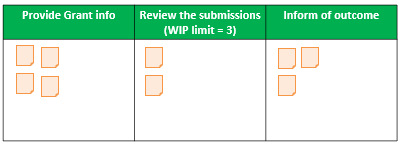
Kanban advocates starting with small improvements from the current state and by first examining the system around the work. It is is more than just a method that uses a board with three columns: To-Do, Doing, Done.
Here, we provide an overview to the key steps to help start with designing a meaningful Kanban system that teams can iterate and improve on continuously.

Step 1: Alignment
Vision and Purpose
Be it product development, maintenance or operations work, it is essential to start with a good understanding of the customer’s needs and align with the key stakeholders and development team on the value to be created for the target customer. Thereafter, define the shared objectives and key results to achieve together. This alignment creates the purpose for a team to work together.
The approach for creating this alignment is outlined in Agile Delivery – Step 1: Alignment.
Define Fit-for-Purpose Metrics
In order to satisfy the customer’s needs and stay on track, the right fit-for-purpose metrics (key results or measures of success) help to improve decision-making and create positive impact. The 4 common types of metrics are:
Customer fitness criteria – Varies for different customer segments and markets. E.g. Time-to-market, quality, etc.
Heath indicators – Provide signals of whether the organisation or team is functioning healthily, e.g. increasing work-in-progress items, lead time, etc.
Improvement drivers – Used to drive positive changes, and may be a specific target for temporary use or converted to a health indicator when the target is achieved.
Vanity metrics – Avoid these as much as possible, as these do not help to drive product success or customer satisfaction. An example would be the number of visitors to a page, but the customer obtains value only upon registration.
Step 2: Identify the Pain Points
Find out about the Current Pain Points
Gather information about the pain points (dissatisfactions) from various stakeholders, customers, users and even the product, maintenance or operations team itself.
Consider the different group of people interacting within (internal) and outside (external) of the team and processes for delivering value.
- Internal - Pain points that prevent the team from delivering value to meet expectations. E.g. Poor quality service or product, late delivery, overloaded team
- External – Pain points of the customers. E.g. Receiving poor quality service or product, having to wait in queue on a hotline, not knowing when they will hear back about an issue, etc.
By understanding the sources of dissatisfaction, the team or organisation can then manage their expectations, and also that of their stakeholders. A decision can also be made as to what to improve on when designing the Kanban system.
Engage various groups of users
Getting a good amount of representation across the various groups within and outside of the system helps to ascertain how severe the pain point is and how often it occurs.
The team can then decide which dissatisfactions to resolve first when designing the Kanban system, and experiment with the improvement actions.
Inputs can be collected via interviews, focus groups, surveys or by conducting observations of the users interacting with the product.
Collect the Inputs
- Identify the different stakeholders, customers and team members to engage. Find out where the pain point is experienced in the process of delivering value, and to what extent.
- Categorise the dissatisfactions collected as “Internal” or “External” – Indicate how often it occurs, the impact and duration that it lasts.
- Document these inputs in a common location accessible by the team.
Step 3: Determine the Demand & Capabilities Needed
Determine the Demand
To have an effective and efficient system to deliver value and meet the customer’s expectations, is to truly understand the customer demand.
To determine the demand, identify:
- Where are the new work items coming from and from whom? – Knowing this, the team will be able to reach out to the other party and understand or clarify expectations or estimate the upcoming volume of requests.
- How fast or how often are these new work items arriving to the team’s system? - Often this is about noting the average number of, for example, requests, coming to the team within a defined period (a week, month, etc.)
- What are the customers’ and stakeholders’ expectations of the service or product to be provided, and the expected timeline?
Categorise the Incoming Requests
When the team understands the demand, it will be able to identify the key characteristics of the incoming requests and categorise the requests into different work types.
The different work types may be handled differently and the team is able to better organise themselves within the system to handle each work type effectively and efficiently.
The work types may sometimes be represented as swimlanes in the Kanban board that visualizes the team’s system.
Determine the Capabilities Needed
As the Kanban method focuses on starting from where the team is at, it is possible to examine historical data on the extent to which demand is handled in the past. This will help the team determine trends, patterns or habits.
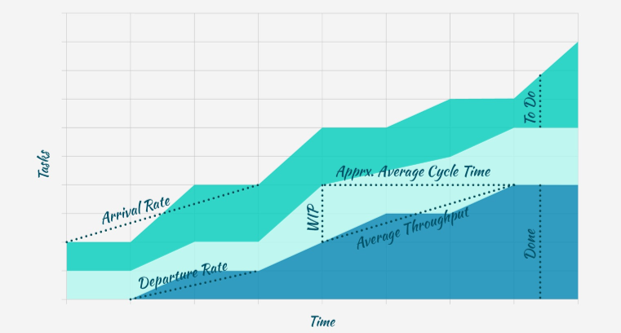
The key thing is to determine where the demand matches, or is on par with the team’s delivery capacity, i.e. the rate of requests reaching the team is almost the same as the rate of requests leaving the team (completed or dropped).
It is usually helpful to plot a cumulative flow chart.
Step 4: Visualise the Value Stream
Identify the Value Stream & Stages
Through interviews with or observations of the team doing the work, it is possible to identify the key activities that have to be completed to deliver value to the customers. This is known as a value stream.
A starting point for the team to identify their value stream is to ask about their work flow or business process.
Map out the current value stream – Ask the team to provide the steps for the work they do, so the customer can receive value.
Mark out the parts of the current value stream where the pain points are.
Generate ideas for reducing or eliminating these pain points.
Map the to-be value stream.
Test the to-be value stream by using it to model the team’s Kanban system.

Step 5: Assemble the Kanban System
Define what each Work Stage means
Once the work stages are identified, the team can include these information to start building up their Kanban system:
- Work-in-Progress Limit – For a work stage, what is the maximum number of items that can be worked on simultaneously?
- Work Policies – What constitutes a work item going from one work stage to another? Explicit work policies include Definition of Done, Service Level agreements, etc.
Prioritise the Work Items
To prioritise the incoming and work-in-progress (WIP) items, these Classes of Services help teams to cope with demands and focus on the most valuable items:
- Expedite - Top priority, costs are high if delayed
- Fixed delivery date - Fixed due date, high cost if not delivered on time
- Standard – Due date is a range, moderate cost of delay
- Intangible – No due date, little to no cost of delay