StackOps Resiliency Accelerator (SORA)
StackOps Resiliency Accelerator (SORA) is v3 of StackOps Observability Accelerator (SOA).
Developed by StackOps, StackOps Resiliency Accelerator (SORA) v3 is a CLI tool that fast-tracks observability setup, reducing the complexity of configuration and deployment:
- Automated connectivity—Easily establish a secure and private connection between your cloud environment and Elastic Cloud.
- Resource discovery—Automatically discover unmonitored resources (EC2, ECS, RDS, VMs, and so on) to ensure full visibility into your infrastructure.
- Agent deployment—Deploy agents to collect logs and metrics with zero manual configuration.
SORA currently supports the following monitoring tools:
- AWS Cloud Native (e.g., CloudWatch, CloudTrail)
- Azure Cloud Native (e.g. Azure Monitor)
- StackOps Elastic
Access the SORA documentation.
Why use SORA?
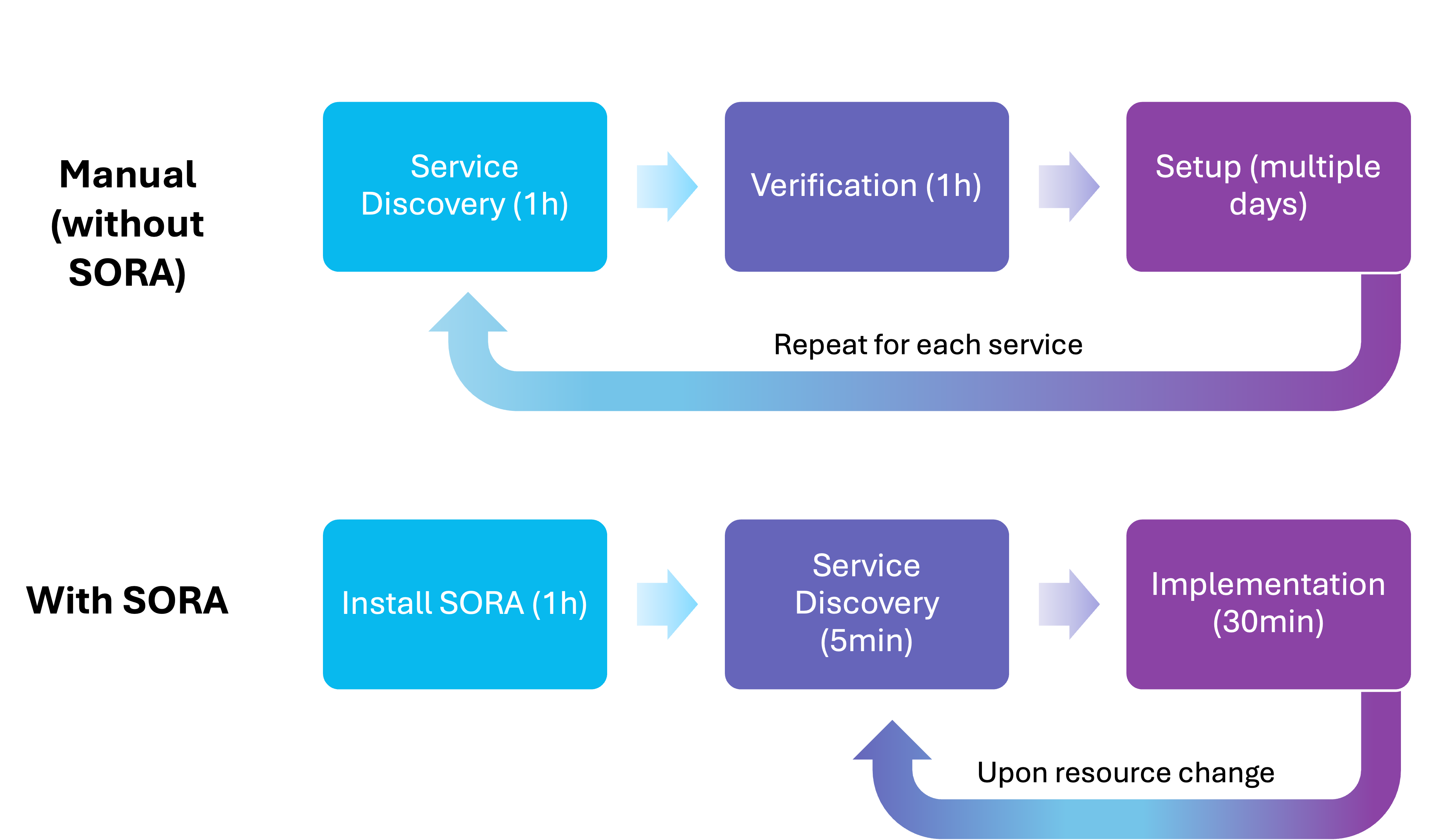
Setting up observability involves discovering unmonitored resources, verifying the resources and other details, and setting up Elastic Agents. This process is manual and takes several days to set up — repeated for each resource.
Using SORA, this process is optimised so you only need to run a few commands periodically — SORA will discover any resource changes and automatically generate configuration files to deploy Elastic Agents and the necessary integrations to ingest monitoring data. The overall time spent becomes significantly reduced (less than 1 hour). Here is a comparison of the setup process using SORA:
SORA features
SORA discovers unmonitored resources and generates the configurations for deploying any Elastic Agents and integrations to read logs/metrics from your infrastructure. Here is an overview of SORA features:
- Simplified cloud resource deployment— Quickly provisions the minimum required resources for observability using Terraform.
- Multi-cloud support—Works with AWS and Azure, supporting both ECS/EC2 (AWS) and equivalent Azure services (WIP).
- Private connectivity—Sets up VPC Endpoints (AWS) or Private Endpoints (Azure) for secure, private communication between agents and Elastic services.
- Resource discovery—Identifies unmonitored resources to ensure comprehensive observability coverage.
- Elastic Agent integration—Deploys Elastic Agent to collect and forward logs and metrics to ElasticSearch.
- Command-line interface—Easy to use locally, in CI/CD pipelines, or within Docker containers for automated workflows.
- CI/CD & Docker friendly—Can be seamlessly integrated into CI/CD pipelines and run in Docker environments for consistent, repeatable deployments.
Improvements to SORA
SORA v3 brings significant improvements compared to SOA v2:
- Simpler distribution and maintenance—Get started and stay updated with SORA more easily, thanks to one-line install script, platform-specific update tarballs, and oclif-based distribution.
- Improved CLI UX—Easily master SORA with its robust command UX, integrated help, and built-in self-update support.
- Reduced operational overhead—Preview changes before applying them, and deploy and teardown with consistent stack state with SORA’s Pulumi-based deployment.
- Improved operational visibility—Handle errors with centralized logging (with structured summaries, progress indicators, and error details) and clearer command failures.
- Faster time-to-value—Set up observability with SORA’s comprehensive 9-stage discovery pipeline, from resource discovery to deployment-ready configuration generation.
- Improved reliability—Runtime data are stored in stage-specific caches, eliminating gaps in memory.
- Telemetry collection—SORA now collects telemetry data to improve tool quality and reliability, with opt-out options.
Refer to SORA v3.0.0 release notes for more information.
Getting started with SORA
Refer to the SORA documentation to get started with SORA. It contains detailed installation and migration guides, command references, configuration examples, and troubleshooting resources.
Note:
- A StackOps subscription is not required to install and use SORA.
- SORA v3 currently does not have full feature parity with SOA v2. Refer to SORA documentation for more details on the roadmap.
- If you are connected to the SilverGate WiFi, there is currently a DNS resolution issue that may affect the installation. The issue is under investigation. As a temporary workaround, set 1.1.1.1 in the DNS configuration.
Migrating from SOA v2 to SORA v3
Refer to the SORA documentation to migrate from SOA v2 to SORA v3. Because the configuration files in SORA will have a new format, you need to regenerate them with SORA before deployment.
Breaking changes
Here are some notable changes in SORA v3:
- Changes to runtime and tooling
- Node.js 22+ required
- Binary rename:
soatosora
- Changes to commands (e.g.,
implementtodeploy) and flags - Changes to state defaults and default configuration paths
Refer to SORA documentation for more details.
Initial release scope
The initial SORA release intentionally supports a subset of legacy SOA coverage:
sora discover aws-elasticsora deploy aws-elastic agentsora delete aws-elastic agent
Support timeframe
SOA v2 and SORA v3 will be supported in parallel until 31 Aug 2026. From 1 Sep 2026, SOA v2 will be deprecated.