IM8, Privacy Risk and Utility
The trade-off between privacy risk and loss of data utility seeks to minimise the latter. This also requires reducing the risk of identification and sensitive data fields disclosure to an acceptable level.
The risk-utility scale extends between two extremes:
- Maximum privacy, in which no data is released (zero risk of disclosure) leading to no utility from the data; and
- Maximum utility, in which data is released without any privacy protections, entails the maximum risk of disclosure but also offers the highest level of utility.
The goal of well-applied anonymisation is to find the optimal point where utility for end users is maximised at an acceptable level of risk. What this acceptable trade-off is depends on factors such as the sensitivity of the data, the risk posture of the organisation, and what kind of environment the data is being handled in.
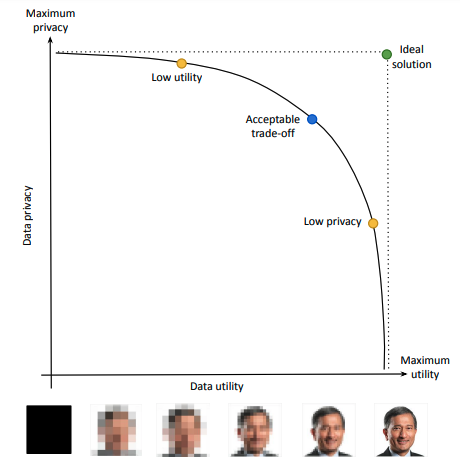
The privacy-utility trade-off curve, illustrating how increasing data privacy reduces utility and vice versa, with the goal of finding an acceptable balance.
How K-Anonymity and Re-Identification Risk Relate
Cloak reports both k-anonymity and re-identification risk. These are not separate concepts - they are a direct mathematical function of each other:
- K-anonymity describes the size of the group a record is hidden in: every record shares its indirect identifiers with at least (k - 1) others.
- Re-identification risk is the inverse: the probability that an attacker could correctly identify a specific individual from that group.
The formula is: max re-identification risk = 1 / k
| If k-anonymity is… | Max re-identification risk is… |
|---|---|
| k = 1 (unique record) | 1/1 = 100% |
| k = 2 | 1/2 = 50% |
| k = 3 | 1/3 = 33% |
| k = 5 | 1/5 = 20% |
| k = 10 | 1/10 = 10% |
When Cloak’s report shows a maximum re-identification risk of 100%, this means there is at least one record with a unique combination of indirect identifiers (k = 1). When the risk drops to 33%, this means all records share their indirect identifiers with at least 2 others (k = 3).
Access Modes and WOG Guidelines
When you start a tabular anonymisation job in Cloak, the first decision is to select an access mode. This determines the level of anonymisation required based on how the data will be accessed after release.
| Mode A | Mode B | Custom | |
|---|---|---|---|
| Access type | Unrestricted access within specified environment | Controlled access in a sanitised environment | User-defined |
| Level of control | Little to no control over how end-user accesses and uses data | Good control and monitoring over how end-user accesses and uses data | N/A |
| Use cases | Datathons, light analytics, public release | Policy evaluation, programme evaluation | Ad-hoc implementation of specific techniques |
| Treatment | Heavy anonymisation; re-identification test required | Light anonymisation; re-identification test optional | As configured by user |
| K-anonymity guideline | k ≥ 5 (max re-ID risk ≤ 20%) | k ≥ 3 (max re-ID risk ≤ 33%) | User-defined |
These modes relate to IM8 Data Access and Distribution (Clause 3) guidelines on k-anonymity for data sharing beyond the public sector. They are guidelines rather than hard requirements - the appropriate threshold depends on the use case, data classification, access conditions and residual-risk decision.
If you select Mode A or Mode B, Cloak will assess your dataset against the corresponding threshold in Step 3 and indicate whether your data meets the guideline. If you select Custom Mode, you define your own target k-value.
While these guidelines are primarily intended for data sharing beyond the public sector (where risks are typically higher), they are useful concepts for data protection in any context - including intra-agency sharing and internal data handling - as a way to assess and benchmark the residual re-identification risk in a dataset.
The Iterative Process
Choosing anonymisation techniques in practice entails a series of iterations:
- Assess current risk: Calculate existing k-anonymity and re-identification risk using Cloak.
- Apply anonymisation measures: Apply transformations (generalisation, suppression) to reduce risk. Cloak can recommend transformations aligned to WOG Mode A/Mode B requirements.
- Re-assess residual risk: Review the risk and utility metrics after anonymisation and determine if the resulting trade-off is acceptable.
If the risk is not sufficiently reduced or the utility loss is too high, adjust the transformations and re-assess. If the anonymised dataset is satisfactory for the use case and context, it can be released.
Need help? Try our Support Assistant or visit the Support page.