Train According To Needs

Now that you’ve got your overall organisation structure in place, it is time to bridge the skills gap by leveling up your officers’ data literacy knowledge and helping them gain the necessary data skills. When devising a training programme for the whole organisation, it is important to consider and customise accordingly based on the staff’s role in the data transformation efforts, his job role and technical foundations.
Recognizing that there is no one-size-fits-all training programme, a Competency Framework which targets varying degrees of proficiency will allow each staff to be trained up to different technical complexities based on job roles and persona within the organisation. The courses identified for each level can range from self-learning for the data literacy level to formal workshops and courses for the basic and intermediate as well as a combination of online and face-to-face learning for advanced capabilities.
Referencing A Competency Framework
To guide your upskilling efforts, it is useful to reference a Competency Framework that charts out the progression of Data Science capabilities across 5 levels: data literacy, basic, intermediate, advanced and expert. The onion diagram below is an example of a framework that represents different technical complexities based on job roles and persona within the organisation, not just the data science team.

1. Data Literacy Level
Data Literacy Course
Regardless of the domain and level a staff may be at, there are rich sources of data that are waiting to be transformed into insights and products. As such, all staff in the organisation should strive to achieve a reasonable level of data literacy. It is also useful to not leave it to the staff to pick this up in a laissez-faire manner. The organisation should curate and identify a good learning package for data literacy knowledge, especially if it is contextualised to their own domain, so that it also establishes a common set of lingo for everyone. Some terminologies in the field of data can mean quite different things; for example, not everyone defines data science, data analytics or AI in the same way.
It is important that the data literacy knowledge should cover what is Data Science and AI as well as their applications and some of the hype around it. It should help people understand why good data is important, harness data visualization principles to tell a good data story, develop intuitive understanding of machine learning algorithms and eventually learn how to scope a data project. Through a common set of curated data literacy knowledge, all staff in the organisation will be more familiar with the concepts and terminology used in data science, making it easier to brainstorm and identify DSAI applications.
Within the Singapore Government, we have created a set of Data Literacy ePrimer contents for public officers to take up. The full eLearning is about 4 hours long, and you can reference the set of introductory eLearning videos here:
- Ep 1 - Data Is A Team Sport
- Ep 2 - Data Data Data
- Ep 3 - Once Upon A Chart
- Ep 4 - I Learn, Therefore I Am?
- Ep 5 - I Came, I Saw, I Divide And Conquered
2. Basic Level
Data Skills Course
Besides data literacy, it is important for staff to pick up data skills that they can readily apply at work. The training they receive should cover skillsets on data preparation and data exploration using familiar spreadsheet software like Excel. It is also important for them to pick up and use modern data visualization tools where they can quickly self-service and explore the data or use it to create dashboards and present recommendations to stakeholders. The recommended time commitment for such basic tier courses is about 3 to 5 days. To ensure that leaders have knowledge of the key applications of data analytics and how to use data strategically, it is important for leaders to be trained as well. As it may be difficult to expect the same time-commitment for the leaders, it is recommended that they undergo a 1 to 1.5 days course which covers the concepts and knowledge that will help them appreciate the data work their staff will undertake, and hone their ability to reasonably guide, support and critic the analytics work.
3. Intermediate Level
For an organisation to truly transform into one with high data maturity, it cannot rely just on a team of data scientists and engineers on one end of the spectrum, and a whole group of staff trained up to the Basic tier on the other end. The Intermediate tier is envisioned to be filled by a group of Power Users who, while not at the level of a data scientist, can handle more complex data projects than their basic-tier peers. This level targets users that use data often in their work even though they do not perform a full-time analytics role.
To fully learn to handle more complex data projects, we recommend that the Power Users go through training on a coding language (Python or R). This is so that the staff can script and automate the data cleaning and preparation process. They can also explore the data more effectively and apply some straightforward Machine Learning algorithms through the standard Data Science library packages that are common with Python or R. To learn all these effectively, an estimated 100 hours’ worth of training should be committed here.
4. Advanced and Expert Level
The advanced and expert levels apply to data professionals embarking on full time analytics work. The data professionals will need skillsets from across different competency groups to effectively carry out data projects, as well as build systems and infra.
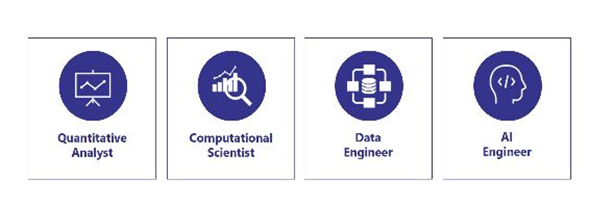
In our case, we categorized the data professionals into 4 different roles – quantitative analyst, computational scientists, data engineers and AI engineers and each will require specialised training of their own. The data science and AI skills required will range from data visualisation, machine learning, data engineering and the skills will be of varying levels of importance depending on the role. Training avenues range from degree or diploma programmes to self-paced online courses or nano-degrees that can provide training up to an entry-level for a data-related role. The recommended entry-level training duration is about 400 hours’ worth of training.
With a clear training roadmap for the organisation, you will now enable every individual in the organisation to be trained up to the right level. The next step is to translate the improved data literacy into actual business outcomes and it is important to ensure that the relevant tools and infrastructure are available to support such work.